Friday, 23 November 2012

Thursday, 22 November 2012
Psycho
* Made in 1960
* Directed by Alfred Hitchock
* Written by Joseph Stefeno and Robert Bloch
* Staring: Anthony Perkins
.jpg/215px-Psycho_(1960).jpg) Janet Leigh
Janet Leigh
Vera Miles
* Directed by Alfred Hitchock
* Written by Joseph Stefeno and Robert Bloch
.jpg)
* Staring: Anthony Perkins
Janet LeighVera Miles
Marion Crane, played by Janet Leigh was a office worker who was trusted to
bank $40,000 dollars for a client of hers. However she took advantage of her employees trust and ran off with the money in search of new life. While
Marion was making her escape she decided to stay at the Bates Motel, which
was managed by a feeble, young man named Norman. A particular scene
where Norman agreed to let Marion share a meal with himself and his mother
but soon had to refuse his offer due to his mother not allowing this to happen
suggests that she is very demanding and almost controls Normans life. Later
that day while Marion was showering, Normals mother went to Marion's room uninvited and murdered her in the bath. This scene is one of Hollywoods most famous, due to the violence used. Norman unaware of what his mother had done, went to check up on his only customer. To his surprise he found her laying dead in the bathroom. Norman panicked, cleaned up all the mess his mother had created and discarded all evidence that had any relation to the murder. Some days later Marions family reported Marion missing, and got a detective to try and look for her. While the detective was investigating where Marion could have disappeared to, he also crossed the Bates Motel in search for Marion. He had a assumption that Marion may have stayed at the motel due to Normans "fishy" behavior when registering him into the Motel. He rang Marions family to explain the situation and that he would be staying at the motel over night. While the detective was searching around he was also murdered by Normans psycho mother. Norman again found out about the murder and had to discard all evidence as well as hid his mother away. Meanwhile Marions family where waiting anxiously by the phone and decided to take matters into their own hands when not hearing a reply from the detective. Since they knew that the deceive had been at the Bates Motel, Marions sister- Lila and her boyfriend Sam went to the motel to investigate for themselves. While at the Motel, Lila was almost murdered by Normans mother, but was saved by her boyfriend Sam, who held Normans mother hostage until the police arrived at the scene. The police then arrested Normans mother. To everyones surprise Normans mother had actually been dead for some years, and it was Norman dressed as a woman who murders the people. The film ends with Norman being diagnosed as a schizophrenic and him being arrested in a mental institution.
North By Northwest
* Made In 1959
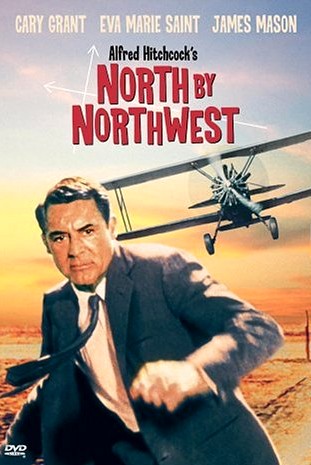 An innocent executive from New York is mistaken for a government agent
video clip of the auction extract.

* Directed by Albert Hitchcock
* Written by Ernest Lehman
* Staring: Cary Grant
Eva Marie Saint
James Mason
An innocent executive from New York is mistaken for a government agent
who named George Kaplan. The innocent man, played by Cary Grant is
then chases across the whole of America by the police aswell as foreign
spies who are trying to take his life! While trying to escape in order to save
his life, George Kaplan is involved in a numerous number of dramatic evens.
One of theses events took place in a auction house, Where George Kaplan
feels he will be killed if he leaves the venue alone, therefore causes havoc so
he can be arrested and saved from death. During the film George Kaplans path crosses with Mrs Eva Kendall played by actress Eva Maria Saint. The two soon become emotionally as well as physically attached to each other. It seems as tho the two are in love, but as the film unfolds we release that this isnt the case. The views are then let in on a secret, Eva Kendall isnt actually the innocent bystander that we all thought she was but instead is a sneaky spy. As far as us the audience know, the film ends with Eva Kendall and Geroge Kaplan traveling away together on a train as a couple.
Thursday, 8 November 2012
Sound (Key Words)
Sound is one of the most important elements of a film. Here are some key words related to sound.
Diegetic: When the sound being played belongs to what is being shown on screen.
Non Diegetic: The opposite to Diegetic...when the sound being played doesn't belong to the film.
Sound Bridge: When sound acts as a bridge to help aid a transition between two scenes.
Parallel Sound: When what is being displayed on screen has relevance to the sounds being played. They complement each other.
Contrapuntal Sound: When the sound and image on screen have no relation what so ever. When they contrast each other.
Dialogue: When two are more characters engage in a conversation.
Sound Effects: Sounds introduced while editing (Extraneous variables).
Diegetic: When the sound being played belongs to what is being shown on screen.
Non Diegetic: The opposite to Diegetic...when the sound being played doesn't belong to the film.
Sound Bridge: When sound acts as a bridge to help aid a transition between two scenes.
Parallel Sound: When what is being displayed on screen has relevance to the sounds being played. They complement each other.
Contrapuntal Sound: When the sound and image on screen have no relation what so ever. When they contrast each other.
Dialogue: When two are more characters engage in a conversation.
Sound Effects: Sounds introduced while editing (Extraneous variables).
On Screen Transitions
On screen transitions are use to change from a scene to another scene smoothly and effectively in a film. Here are a few of the most common types of transitions used in films along with a description of how they are preformed.
Straight Cut: When one shot moves instantaneously to the next without catching the views attention.
Dissolve: A layering effect used. One shot slowly dissolves into a new shot.
Fade: When the scene gradually darkens or lightens until the how screen is completely black or white. When the film reappears it will be on a different scene.
Wipe: When one image is pushed off the screen by a new image.
Graphic Match: When a feature from the previous scene is paired to a similar feature in a new scene.
Straight Cut: When one shot moves instantaneously to the next without catching the views attention.
Dissolve: A layering effect used. One shot slowly dissolves into a new shot.
Fade: When the scene gradually darkens or lightens until the how screen is completely black or white. When the film reappears it will be on a different scene.
Wipe: When one image is pushed off the screen by a new image.
Graphic Match: When a feature from the previous scene is paired to a similar feature in a new scene.
Lighting (Key Words)
Lighting is the arrangement of lights on set which help to create a particular effect or emotion. There are different types of lights placed in many different positions on set to help create any desired theme, here are the names of a few lighting techniques along with their definitions.
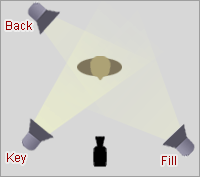
Key Light: Main Light used on the subject.
Filler Light: Used to soften the harsh key light and helps to eliminate shadows.
Back Light: Counters the key light, and allows the subject to appear more "round"
Under Light: When the primary source of light is originated below the subject. (used in horrors.)
Top Light: When the main source of light comes from above the subject. (highlights subjects features.)
Low-Key Lighting: A sharp contrast between light and darkness created via only the key and back lights.
High-Key Lighting: A bright, day light effect created via the use of more filler lights.
Welcome!
Hey, I am Ryan Inayat and WELCOME to my blog.
This is where i will be posting all the work i do throughout the year.
Enjoy
This is where i will be posting all the work i do throughout the year.
Enjoy
Subscribe to:
Posts (Atom)